triquetra
Recently one night when I was trying to fall asleep, I saw a vision in my mind of three intersecting circles. I tried to picture what shape would appear in the areas of intersection but couldn't clearly see it. Last evening, despite my lack of drawing skills, I sketched the three circles joined together. As it turns out, this ancient symbol is called a triquetra, representing a variety of spiritual/religious ideas, prominent among them the Holy Trinity. Often it is difficult to articulate a concept merely with words, so a symbol such as the triquetra operates to deepen understanding through a visual and metaphorical representation. The concept is grasped intuitively as well as intellectually.
The shape of the intersecting areas resembles a flower or a bird, such as a dove, both feminine symbols, and I saw clearly a trinity within a trinity, where the inner region is part and parcel of the surrounding circles. My working theory is that this hidden, inner region represents the feminine aspect of God, which I believe is most accurately named Holy Wisdom (Sophia in Greek). Just who is Wisdom? I certainly do not claim to have a perfect vision of what I wish to convey, but I have delved deeper into this mystery of the sacred feminine, and these are some of my findings.
"Sophia can be described as the wisdom of God, and, at times, as a pure
virgin spirit which emanates from God. The Sophia is seen as being expressed in all creation and the natural world as well as, for some of the Christian mystics..., integral to the spiritual well-being of humankind, the church, and the cosmos. The Virgin is seen as outside creation but compassionately interceding on behalf of humanity to alleviate its suffering by illuminating true spiritual seekers with wisdom and the love of God" (Wikipedia).
Sophia by Mary B. Kelly
There are too many biblical references to transfer here, but these are some key passages on the nature of Wisdom:
"
For in her there is a spirit that is intelligent, holy, unique, manifold, subtle, mobile, unpolluted, distinct, invulnerable, loving the good, keen, irresistible, beneficent, humane, steadfast, sure, free from anxiety, overseeing all, and penetrating through all spirits that are intelligent and pure and subtlest. For Wisdom is more mobile than any motion;
because of her pureness she pervades and penetrates all things. For she is a breath of the power of God and a pure emanation of the glory of the Almighty; therefore nothing defiled gains entrance into her. For she is a reflection of eternal light, a spotless mirror of the working of God, and an image of his goodness. Though she is but one, she can do all things, and while remaining in herself, she renews all things; in every generation she passes into holy souls and makes them friends of God and prophets; for God loves nothing so much as the man who lives with Wisdom. For she is more beautiful than the sun and excels every constellation of the stars. Compared with the light, she is found to be superior, for it is succeeded by the night, but against Wisdom evil does not prevail. She reaches mightily from one end of the earth to the other, and she orders all things well" (Wisdom 7-8:1).
Here Wisdom is portrayed as an emanation, rather than a creation, as she seems to be elsewhere. Perhaps in the case of Wisdom, the word
creation has the connotation of giving birth, as in the creation of a poem or song that is not only crafted, but is brought forth by the artist from a divine source. Proverbs 8: 22-31 describes Wisdom as being "brought forth", which is a definition of giving birth or being
fathered:
"The Lord possessed me at the beginning of his work, the first of his acts of old. Ages ago I was set up, at the first, before the beginning of the earth. Where there were no depths I was brought forth, when there were no springs abounding with water. Before the mountains had been shaped, before the hills, I was brought forth, before he had made the earth with its fields, or the first of the dust of the world. When he established the heavens, I was there; when he drew a circle on the face of the deep, when he made firm the skies above, when he established the fountains of the deep, when he assigned to the sea its limit, so that the waters might not transgress his command, when he marked out the foundations of the earth, then I was beside him, like a master workman, and I was daily his delight, rejoicing before him always, rejoicing in his inhabited world and delighting in the children of man."
Sophia by Hildegard of Bingen
Sophia, in Catholic theology, is the Wisdom of God and is thus eternal. In my vision, Sophia is co-existent with the Trinity, part and parcel of it, operating as the feminine, motherly aspect of God in concert with the three masculine principles of the Father, Son, and Holy Spirit. As I've before stated in regard to the Catechism, God is pure spirit and is not separated into the masculine and feminine as human beings are. Mine is a human attempt to illustrate a divine concept. It seems to me that Sophia, while contained by the whole Trinity, specifically flows out from the Holy Spirit. Rather than being a fourth member of the Trinity, she is a divine spirit who is
of the Trinity, the feminine principle brought forth to reflect the Father, Son, and Holy Spirit. She is hidden within the Trinity, mirroring God's glory, grace, power, and love, like the moon reflects the sun.
Holy Wisdom emanates from God and is particularly associated with the bridal-maternal function of the Holy Spirit which I have previously described, borrowing from Scott Hahn's terminology in
First Comes Love. Continuing on my reflections of his themes, I perceive a tri-fold parallel between three persons comprising the Sophia and the three familiar persons of the Trinity. Holy Wisdom corresponds to the Father (see Luke 7: 33-35, Wisdom as Mother); Ecclesia (the Church, the Bride of Christ) to the Son; and Shekinah (the presence of God strongly associated with the Ark of the Covenant) to the Holy Spirit. In this way both the masculine and the feminine are represented within the three circles of the Trinity. I see no way in which this idea contradicts the teaching of the Church, but rather provides a mystical interpretation of the nature of God as both paternal and maternal, as the Catechism states.
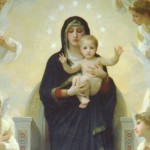
Coronation of Mary
As my concept of Sophia relates to the Virgin Mary, I see that the Immaculate Heart of Mary mystically represents Sophia at the heart of the Trinity. Mary can be understood as the mystical sanctuary of the Holy Spirit by virtue of the Incarnation of Jesus through her. Mary's Assumption and Crowning in heaven portray the divinization that she received by virtue of God's grace and Jesus' redemptive act on the cross, and His resurrection, which is the hope of all Christians. Mary also reveals the indwelling Sophia, or feminine aspect of God, in the ancient archetype of Mother, Maiden/Bride, and Wise Crone, corresponding with Holy Wisdom, Ecclesia, and Shekinah. Mary was not divine; she was completely human, but she partakes in the divinity of her Son, as we find explained in 2 Peter 1: 3-4:
"His divine power has granted to us all things that pertain to life and godliness, through the knowledge of him who called us to his own glory and excellence, by which he has granted to us his precious and very great promises, so that through them you may become partakers of the divine nature, having escaped from the corruption that is in the world because of sinful desire." The faithful are all destined to become kings and queens, sons and daughters of God. The divine feminine is also glimpsed through Ecclesia and her relationship to the Holy Spirit, which is analogous in a certain way to the Incarnation:
"In the Divine Mind, in God's Archetypal Idea of creation, the Holy Trinity eternally sees Ecclesia as intimately united to Christ and 'ensouled' by the Holy Spirit. She so partakes in the divine life that she is, with Jesus Her Divine Spouse, the end of creation, which God made with her in mind and for her sake. The Church of the Living God is no mere human institution; she is
Ecclesia Mater, 'spread out through all time and space and rooted in eternity, terrible as an army with banners'. Our minds cannot comprehend the length, width, height and depth of our loving, all-embracing, cosmic Mother.
Ecclesia (pronounces eh-
klay'see-uh), the Latin word for 'Church', is sometimes used as a proper name when one wishes to emphasize the fact that Holy Mother Church is a mystical Person, not a mere society or organization, as the word 'Church' might imply to some" (from the Mystical Rose Catholic Page).
Finally, Mary is associated with the Shekinah by virtue of her identification as the "Ark of the New Covenant" portrayed in Revelation 12, as the woman clothed with the sun, with the moon beneath her feet and a crown of 12 stars on her head. This woman is
woman, Mary, the new Eve, daughter Zion, Ecclesia. Mary is the holy face through which we recognize the sacred feminine, or Holy Wisdom, who we also experience as "Mother Nature", Mother Church, Bride of Christ; and Shekinah, the presence of God.