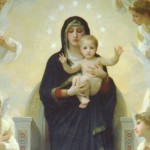
“I, the fiery life of divine essence, am aflame beyond the beauty of the
meadows. I gleam in the waters, and I burn in the sun, moon and stars . . . . I awaken everything to life.” --the voice of God revealed in the visions of St. Hildegard von Bingen and recorded in her book, Liber Divinorum
Just to explicate a little further on the Motherhood of God in the Trinity, I will use a human analogy. The feminine principle, which I will call the "Bride", is contained within the Father. Human marriage symbolizes this divine union, a God who has both a masculine and a feminine nature. The Son is generated from this union. The Holy Spirit comes into personhood as the maternal Love proceeding from the Father and Son, as a woman (bride) becomes fully mother only once her child is born. The Father, then, is also inherently "Mother". Ruah Ha Kodesh, the Holy Spirit, can be mystically understood as the womb of God. St. Hildegard of Bingen, recently made Doctor of the Church, saw the universe as an egg contained in the womb of God:
Hildegard, called the Sibyl of the Rhine, saw a vision from God of divine, feminine beings who were named Sapientia, Ecclesia, and Caritas. These Latin words, respectively, mean Wisdom, Church, and Love. While orthodox in her Catholicism, God appeared to Hildegard as Mother. Her trinity of the divine feminine is almost exactly akin to my vision of Sophia at the heart of the Trinity, with the correspondences of Holy Wisdom, Holy Mother Church, and Shekinah (divine presence/glory cloud). Surely Love is the divine Presence. Ecclesia revealed herself to Hildegard as "the true, hidden Church". Again the theme of the hidden quality of the feminine nature of God comes to the fore. The following poem seems to indicate the feminine trinity within the Trinity. Note the third wing which "hovers everywhere", a clear reference to the action of Ruah Elohim, the Spirit of God.
O power of wisdom!
You encompassed the cosmos,
Encircling and embracing all in one living orbit
With your three wings:
One soars on high,
One distills the earth’s essence,
And the third hovers everywhere.
Hildegard von Bingen, O virtus sapientia
In September of 1999, Pope John Paul II told a crowd of pilgrims at St. Peter's Square that God has both a male and female nature and can be referred to as "God the Mother". A similar declaration had been made by his predecessor, Pope John Paul I, shortly before his death, who said, "God is both mother and father and is more mother than father." There is a long stream of Catholic tradition which acknowledges the motherly nature of God and the association of Lady Wisdom with the Holy Spirit, understood in feminine terms both by some early Fathers of the Church and in Judaism, before the birth of Christianity. Yet it seems that this tradition has been intentionally suppressed, and language about God remains terribly lopsided toward the patriarchal. Let us walk with the sainted abbess Hildegard awhile and see what else our Holy Doctor might reveal...
Marian Devotion, Mystical Catholicism, the Sacred Feminine in Christianity
Showing posts with label Holy Spirit. Show all posts
Thursday, December 13, 2012
Tuesday, November 6, 2012
God as Unity
God is beyond human comprehension in a certain sense, but we can have a personal relationship with the Almighty. God is neither male nor female. God's revealed name is the Father, the Son, and the Holy Spirit. We can know something about God's nature through the Bible and Church Tradition, and through the guidance of the Holy Spirit in personal revelation. Yet we are still limited by human language and symbolism to grasp and articulate the ineffable mystery of the triune Godhead. If we are humble, we acknowledge what little we actually know.
As both women and men are made in the image of God, we can use language for God in both masculine and feminine terms. The truest way I have found to comprehend the nature of God is as the spiritual unity of the masculine and feminine dimensions of being. Again, God is not divided into male and female principles; God is pure spirit. When I refer to masculine and feminine principles, it is by way of analogy to our human condition and our ideas regarding the qualities typically associated with a particular gender. The creation story of Genesis and the marriage of man and woman teach that men and women together are a symbol of the sacred unity that exists in God. A man and woman being flesh of the same flesh and bone of the same bone, coming together in love and open to procreation, gives us a glimpse into the divine nature. God is the perfection of family relationship. At the same time, both men and women are unique, equally valid images of the divine.
So when I point out that names like Ruah, the Hebrew for Spirit, and Hokmah and Sophia (Hebrew and Greek for Wisdom, respectively) are feminine in gender, that is not to say that God is a woman any more than God is a man. It is to emphasize that Elohim, the Hebrew name for God, is grammatically expressive of a divinity that perfectly contains the union of what we understand as male and female, and that this gives us a clue to follow.
To incorporate the language of Mother in reference to God, or to refer to the Holy Spirit as "she" in some cases, such as in the manifestation of the Spirit as Lady Wisdom, in no way infringes upon divine revelation. To call God both "he" and "she" simply equalizes theological language that has excluded the truth of the unity of God, that has historically been excessively patriarchal, resulting in untold damage to the psyche and spiritual life of all humankind. Not to mention the devastation of planet Earth, so often characterized in feminine terms and treated in ways that parallel violence toward women. Nevertheless, it would not be appropriate to change the revealed name of the Trinity--the Father, the Son, and the Holy Spirit. Also, for the matter of consistency, the use of male pronouns for all members of the Trinity in the liturgy is perhaps more efficacious. This would not exclude, however, sermons and homilies that focus upon the motherhood of God or references to God's "feminine face", as I have occasionally heard spoken by priests at Mass. Then again, referring to the Holy Spirit as she in some contexts in order to reflect the often bridal-maternal nature of this divine Person within the Trinity would most fully characterize God as divine family unity, that which our human family unity mirrors.
Names like Spirit-Sophia, used by Catholic theologian Elizabeth A. Johnson, point to the personification of the Holy Spirit as "Lady" in the Wisdom Books of the Bible. Holy Wisdom as "she" is not merely a grammatical coincidence; it is a full-fledged theology of the Spirit of God in bridal-maternal terms. The Holy Spirit could rightly be called the mystical "feminine nature" of the Trinity. Like all members of the Godhead, the Spirit is fully an expression of divine unity. However, the "Mother Love" of God is most clearly revealed through the Third Person. And Mary, being the sanctuary of the Holy Spirit and Mother of the Church, reveals so personally the sacred feminine in divinity. Jesus said that those who have seen him have seen the Father. Likewise, a personal relationship with Mary helps us to "see" the Holy Spirit/Sophia. This is why, especially in a heavily patriarchal culture, Marian devotion must be emphasized and encouraged, not marginalized. More homilies, hymns and prayers to Mary in the liturgy, and fuller celebrations of her feast days (that is, a return to more traditional expressions of devotion), would provide a greater balance to our community worship.
How we name things does matter. A rose by any other name may very well smell as sweet, but the name of rose brings to mind vividly what the rose is and what it symbolizes. Exclusively male terms for God do not bring to our minds and hearts the truth of God's unity or the fullness of God's love. Woman must understand that she is as complete an expression of the image of God as is man, and man must also comprehend this revelation.
As both women and men are made in the image of God, we can use language for God in both masculine and feminine terms. The truest way I have found to comprehend the nature of God is as the spiritual unity of the masculine and feminine dimensions of being. Again, God is not divided into male and female principles; God is pure spirit. When I refer to masculine and feminine principles, it is by way of analogy to our human condition and our ideas regarding the qualities typically associated with a particular gender. The creation story of Genesis and the marriage of man and woman teach that men and women together are a symbol of the sacred unity that exists in God. A man and woman being flesh of the same flesh and bone of the same bone, coming together in love and open to procreation, gives us a glimpse into the divine nature. God is the perfection of family relationship. At the same time, both men and women are unique, equally valid images of the divine.
So when I point out that names like Ruah, the Hebrew for Spirit, and Hokmah and Sophia (Hebrew and Greek for Wisdom, respectively) are feminine in gender, that is not to say that God is a woman any more than God is a man. It is to emphasize that Elohim, the Hebrew name for God, is grammatically expressive of a divinity that perfectly contains the union of what we understand as male and female, and that this gives us a clue to follow.
To incorporate the language of Mother in reference to God, or to refer to the Holy Spirit as "she" in some cases, such as in the manifestation of the Spirit as Lady Wisdom, in no way infringes upon divine revelation. To call God both "he" and "she" simply equalizes theological language that has excluded the truth of the unity of God, that has historically been excessively patriarchal, resulting in untold damage to the psyche and spiritual life of all humankind. Not to mention the devastation of planet Earth, so often characterized in feminine terms and treated in ways that parallel violence toward women. Nevertheless, it would not be appropriate to change the revealed name of the Trinity--the Father, the Son, and the Holy Spirit. Also, for the matter of consistency, the use of male pronouns for all members of the Trinity in the liturgy is perhaps more efficacious. This would not exclude, however, sermons and homilies that focus upon the motherhood of God or references to God's "feminine face", as I have occasionally heard spoken by priests at Mass. Then again, referring to the Holy Spirit as she in some contexts in order to reflect the often bridal-maternal nature of this divine Person within the Trinity would most fully characterize God as divine family unity, that which our human family unity mirrors.
Woman Clothed with the Sun by Duncan Long
Names like Spirit-Sophia, used by Catholic theologian Elizabeth A. Johnson, point to the personification of the Holy Spirit as "Lady" in the Wisdom Books of the Bible. Holy Wisdom as "she" is not merely a grammatical coincidence; it is a full-fledged theology of the Spirit of God in bridal-maternal terms. The Holy Spirit could rightly be called the mystical "feminine nature" of the Trinity. Like all members of the Godhead, the Spirit is fully an expression of divine unity. However, the "Mother Love" of God is most clearly revealed through the Third Person. And Mary, being the sanctuary of the Holy Spirit and Mother of the Church, reveals so personally the sacred feminine in divinity. Jesus said that those who have seen him have seen the Father. Likewise, a personal relationship with Mary helps us to "see" the Holy Spirit/Sophia. This is why, especially in a heavily patriarchal culture, Marian devotion must be emphasized and encouraged, not marginalized. More homilies, hymns and prayers to Mary in the liturgy, and fuller celebrations of her feast days (that is, a return to more traditional expressions of devotion), would provide a greater balance to our community worship.
How we name things does matter. A rose by any other name may very well smell as sweet, but the name of rose brings to mind vividly what the rose is and what it symbolizes. Exclusively male terms for God do not bring to our minds and hearts the truth of God's unity or the fullness of God's love. Woman must understand that she is as complete an expression of the image of God as is man, and man must also comprehend this revelation.
Labels:
Catholicism,
Duncan Long,
Elizabeth A. Johnson,
Elohim,
Holy Spirit,
Holy Trinity,
Holy Wisdom,
Ruah,
Sophia,
Spirit-Sophia,
Virgin Mary,
Woman Clothed with the Sun
Thursday, October 25, 2012
Ruah Elohim
"Again (v., 27), how could Adam (and Eve) be made in the image of the Elohim,
male and female, unless the Elohim were male and female also? The word
Elohim is a plural formed from the feminine singular ALH, Eloh,
by adding IM to the word. But inasmuch as IM is usually the termination
of the masculine plural, and is here added to a feminine noun, it gives
to the word Elohim the sense of a female potency united to a masculine
idea, and thereby capable of producing an offspring. Now we hear much of
the Father and the Son, but we hear nothing of the Mother in the
ordinary religions of the day. But in the Kabbalah we find that the
Ancient of Days conforms himself simultaneously into the Father and the
Mother, and thus begets the Son. Now this Mother is Elohim." (http://www.sacred-texts.com/wmn/wb/wb59.htm)
When I met my husband, I asked him if he had a religion (big question for a first date!). He told me that he practiced Kabbalah, which I had never heard of, so of course I was intrigued. Kabbalah is basically Jewish mysticism. I found a book about this religion so that I could understand what my new boyfriend was into. In Kabbalah, the Tree of Life provides the framework for understanding spiritual levels of being and the nature of God. It's very complex, but the idea that captured my imagination was the explanation of the Hebrew word Elohim, which in English is translated as God. God is obviously a singular word, but when God speaks the words, "Let us" in the creation story of Genesis, we get a glimpse of the trinitarian nature of God, God in three persons. In Catholic tradition, the Son is begotten of the Father, and the Holy Spirit proceeds from both as the Love generated between them. But this begetting and proceeding is a simultaneous process, not a temporal one-after-the-other. I see the Spirit as the "Mother Love" of the Trinity.
As the initial, quoted paragraph above states, Elohim is comprised of a masculine plural added to a feminine noun. When I contemplate Catholic writer Thomas Merton's theology that Holy Wisdom (Sophia) is the Ousia of God, God's primordial essence of being, and that Sophia is inherent to (contained in) all three persons of the Trinity, the meaning of the word Elohim is perfectly crystallized. The Spirit of God is pictured in the creation story, hovering over the waters like a mother bird over her eggs, as the divine power of generation. In Hebrew, this person of the Trinity is named Ruah Elohim. As I have discussed before, Ruah is a feminine word. We find in Ruah Elohim, who is the Holy Spirit (Ruah Ha-Kodesh), the manifestation of the maternal aspect of God. The Holy Spirit is Lord, as the Nicene Creed states, not because the Spirit is particularly male or masculine, but because the Spirit is a divinely equal member of the Trinity along with the Father and the Son, both of whom Sacred Scripture calls "Lord".
It has become increasingly apparent to me that the Lady Wisdom of the Bible fleshes out, so to speak, the nature of the third person of the Trinity. Rather than remaining a kind of impersonal, ambiguous entity running the risk of becoming the marginalized member of the Godhead, we see clearly in Sophia the bridal-maternal character of the Holy Spirit. Furthermore, if we consider the profound indwelling of Mary by the Spirit of Wisdom, especially as articulated by St. Maximilian Kolbe, we can comprehend the basis of Marian devotion as a reflection of the intuitive understanding that the mission of the Holy Spirit is accomplished particularly through the Mother of God.
Kolbe goes so far as to say that Mary is a "quasi-incarnation" of the Holy Spirit, while being clear that this relationship is not the same in nature as the hypostatic union of the divine and human natures of Jesus, who is fully God and fully man. Mary is purely human, but Kolbe sees Mary as the ultimate sanctuary of the Holy Spirit, in as close a relationship as is possible of the strictly human with the divine. Mary does nothing apart from the Holy Spirit. Kolbe teaches that Mary's soul is completely permeated with the Holy Spirit, so her being is in perfect harmony with the mission of this Spirit of Wisdom. According to the saint, this is why Mary could call herself the Immaculate Conception at Lourdes. Because the Holy Spirit is the uncreated Immaculate Conception, Mary is the created Immaculate Conception. Therefore, veneration of Mary reflects adoration of the Holy Spirit.
It is also important to note that this inseparable union between Mary and the Holy Spirit does not obliterate Mary's unique personality and essential qualities as a human being. Because she was from her conception free from sin, Mary could most completely experience God's grace and achieve the holiness that the Spirit worked, and continues to work, in her. Precisely because she is not bogged down and separated from God by a sinful nature, Mary can be that much more Mary. I think that one reason people are so drawn to the Blessed Mother is that we quest for the "authentic self", in pop psychology terms. We see in Mary a fully actualized human being. This is the goal of all mystics who desire unity with God. The more we have Christ in us, the more our true selves we become. By losing ourselves we find ourselves, as Jesus taught his disciples about Life.
At RCIA on Sunday, the teacher talked about prayer and its nature as a personal relationship with God. She said that we can focus prayer to any of the members of the Trinity, in whatever way brings us closer to God. She spoke of being initially confused about the Holy Spirit, but that she is now a "Holy Spirit person". I shared my use of the Hebrew name Ruah for Spirit in my prayers. I find it very beautiful, and for me at this time in my journey, Ruah Elohim, such an eloquently poetic name, is my preferred call to God. It fills my imagination with an image of God that is both Father and Mother, with a focus on the immanent, maternal Presence (Shekinah) of our Holy Creator.
When I met my husband, I asked him if he had a religion (big question for a first date!). He told me that he practiced Kabbalah, which I had never heard of, so of course I was intrigued. Kabbalah is basically Jewish mysticism. I found a book about this religion so that I could understand what my new boyfriend was into. In Kabbalah, the Tree of Life provides the framework for understanding spiritual levels of being and the nature of God. It's very complex, but the idea that captured my imagination was the explanation of the Hebrew word Elohim, which in English is translated as God. God is obviously a singular word, but when God speaks the words, "Let us" in the creation story of Genesis, we get a glimpse of the trinitarian nature of God, God in three persons. In Catholic tradition, the Son is begotten of the Father, and the Holy Spirit proceeds from both as the Love generated between them. But this begetting and proceeding is a simultaneous process, not a temporal one-after-the-other. I see the Spirit as the "Mother Love" of the Trinity.
Mary and the Holy Spirit
As the initial, quoted paragraph above states, Elohim is comprised of a masculine plural added to a feminine noun. When I contemplate Catholic writer Thomas Merton's theology that Holy Wisdom (Sophia) is the Ousia of God, God's primordial essence of being, and that Sophia is inherent to (contained in) all three persons of the Trinity, the meaning of the word Elohim is perfectly crystallized. The Spirit of God is pictured in the creation story, hovering over the waters like a mother bird over her eggs, as the divine power of generation. In Hebrew, this person of the Trinity is named Ruah Elohim. As I have discussed before, Ruah is a feminine word. We find in Ruah Elohim, who is the Holy Spirit (Ruah Ha-Kodesh), the manifestation of the maternal aspect of God. The Holy Spirit is Lord, as the Nicene Creed states, not because the Spirit is particularly male or masculine, but because the Spirit is a divinely equal member of the Trinity along with the Father and the Son, both of whom Sacred Scripture calls "Lord".
It has become increasingly apparent to me that the Lady Wisdom of the Bible fleshes out, so to speak, the nature of the third person of the Trinity. Rather than remaining a kind of impersonal, ambiguous entity running the risk of becoming the marginalized member of the Godhead, we see clearly in Sophia the bridal-maternal character of the Holy Spirit. Furthermore, if we consider the profound indwelling of Mary by the Spirit of Wisdom, especially as articulated by St. Maximilian Kolbe, we can comprehend the basis of Marian devotion as a reflection of the intuitive understanding that the mission of the Holy Spirit is accomplished particularly through the Mother of God.
Kolbe goes so far as to say that Mary is a "quasi-incarnation" of the Holy Spirit, while being clear that this relationship is not the same in nature as the hypostatic union of the divine and human natures of Jesus, who is fully God and fully man. Mary is purely human, but Kolbe sees Mary as the ultimate sanctuary of the Holy Spirit, in as close a relationship as is possible of the strictly human with the divine. Mary does nothing apart from the Holy Spirit. Kolbe teaches that Mary's soul is completely permeated with the Holy Spirit, so her being is in perfect harmony with the mission of this Spirit of Wisdom. According to the saint, this is why Mary could call herself the Immaculate Conception at Lourdes. Because the Holy Spirit is the uncreated Immaculate Conception, Mary is the created Immaculate Conception. Therefore, veneration of Mary reflects adoration of the Holy Spirit.
It is also important to note that this inseparable union between Mary and the Holy Spirit does not obliterate Mary's unique personality and essential qualities as a human being. Because she was from her conception free from sin, Mary could most completely experience God's grace and achieve the holiness that the Spirit worked, and continues to work, in her. Precisely because she is not bogged down and separated from God by a sinful nature, Mary can be that much more Mary. I think that one reason people are so drawn to the Blessed Mother is that we quest for the "authentic self", in pop psychology terms. We see in Mary a fully actualized human being. This is the goal of all mystics who desire unity with God. The more we have Christ in us, the more our true selves we become. By losing ourselves we find ourselves, as Jesus taught his disciples about Life.
At RCIA on Sunday, the teacher talked about prayer and its nature as a personal relationship with God. She said that we can focus prayer to any of the members of the Trinity, in whatever way brings us closer to God. She spoke of being initially confused about the Holy Spirit, but that she is now a "Holy Spirit person". I shared my use of the Hebrew name Ruah for Spirit in my prayers. I find it very beautiful, and for me at this time in my journey, Ruah Elohim, such an eloquently poetic name, is my preferred call to God. It fills my imagination with an image of God that is both Father and Mother, with a focus on the immanent, maternal Presence (Shekinah) of our Holy Creator.
Labels:
Catholicism,
Holy Spirit,
Holy Wisdom,
Jewish mysticism,
Kabbalah,
Marian devotion,
Mother of God,
RCIA,
Ruah Elohim,
Ruah Ha-Kodesh,
Sophia,
Spirit of God,
St. Maximilian Kolbe,
Thomas Merton
Tuesday, October 2, 2012
Why God Is Called Father
"A good book to read concerning power, authority and the politics of language is The Church and the Culture War by Joyce A. Little (Ignatius Press: San Francisco, 1995).
On page 148 of her book, Joyce Little discusses God as Father. 'Now the God of Israel is Holy (Psalm 99). The word "holy" is rooted in the word "separated" (1 Chron. 23:13). God, being pure Spirit, has a certain "separation" or otherness to His material creation. This otherness of God is further revealed when He sent His only Son to the world instead of Himself. Even though we are created in His image, God the Father keeps His distance from matter to a certain extent. For this reason, the title "Mother" is not appropriate for God, since the words: "mother" and "matter", are etymologically related (Latin root: mater-). God is not Mother Nature or Mother Earth. Also mothers during pregnancy are biologically joined to their child, but fathers are physically separated. Even though fathers love their children, there is still a certain degree of distance as compared to mothers. Once again this "separation" of father from child is related to the "separation" (Holiness) of God from creation. The God of Israel is called Father not because He is male, but because He is Holy' " (from the online article, "Mother God" @ http://users.binary.net/polycarp/momgod.html).
The above excerpt is one of the best explanations I have encountered regarding why God is specifically called Father. Though the Bible often uses maternal images to impart understanding of the nature of God, it never calls him "Mother". Little's theology echoes that of George S. Montague in Our Father, Our Mother, with the idea that the male image of fatherhood reflects God's transcendence. While God is equally our Divine Mother, his official title, Father, is connotative of his separateness from creation; that is, we humans are not divine and neither is anything else in the material world. However, God does dwell among us in the 3rd Person of the Trinity, known as the Holy Spirit, who is often especially understood in bridal-maternal terms. But it is Mary, in her complete union with this Spirit of Wisdom, who best reflects the immanence of God's motherly nature. It is she who has been revealed, by Church Tradition through the Holy Spirit, with the titles Mother of God and Mother of the Church, to manifest for us an image of the sacred feminine by which we can most adequately experience God as daughter, bride, and mother.
Using the traditional language, Jesus' incarnation as the God-man can be understood most simply by virtue of his having a divine Father in heaven and a human Mother on earth, making him both fully human and fully divine. His existence as a human being illustrates that we can literally see our Father God in him, and also glimpse God as Mother through his own Mother, Mary, for she is the Mother of God. The way Mary loves Jesus is the way God loves all of his children like a mother. And she also represents the divinized state of being to which we aspire, when we too will inherit a glorified body and live eternally with God as his children. Mary reigns as our Mother, our Sister, our Queen, our Intercessor and Advocate. She is the Mediatrix of All Graces, working in complete harmony with the Holy Spirit of Wisdom who dwells within her to bring about our salvation, not in an equal way to her Son, but uniquely with him.
It still hurts sometimes, this overwhelmingly masculine language ascribed to God. Why is the motherhood of God so hidden? I believe it is because Wisdom, the Sophia at the heart of God, who is equally part and parcel of all Persons of the Trinity, is the Holy of Holies. Without Mary, we just can't get at this mystery at all. Without Mary, the Christian story is truly impoverished and lacking in the fullness of our beautiful faith. Brothers and sisters in Christ, fully embrace God as your Father, for it is a privilege granted to us by our Savior, and also fully embrace Mary as your Mother, for she is Jesus' sweet and holy Gift of Love. With Mary, our family is complete.
On page 148 of her book, Joyce Little discusses God as Father. 'Now the God of Israel is Holy (Psalm 99). The word "holy" is rooted in the word "separated" (1 Chron. 23:13). God, being pure Spirit, has a certain "separation" or otherness to His material creation. This otherness of God is further revealed when He sent His only Son to the world instead of Himself. Even though we are created in His image, God the Father keeps His distance from matter to a certain extent. For this reason, the title "Mother" is not appropriate for God, since the words: "mother" and "matter", are etymologically related (Latin root: mater-). God is not Mother Nature or Mother Earth. Also mothers during pregnancy are biologically joined to their child, but fathers are physically separated. Even though fathers love their children, there is still a certain degree of distance as compared to mothers. Once again this "separation" of father from child is related to the "separation" (Holiness) of God from creation. The God of Israel is called Father not because He is male, but because He is Holy' " (from the online article, "Mother God" @ http://users.binary.net/polycarp/momgod.html).
The above excerpt is one of the best explanations I have encountered regarding why God is specifically called Father. Though the Bible often uses maternal images to impart understanding of the nature of God, it never calls him "Mother". Little's theology echoes that of George S. Montague in Our Father, Our Mother, with the idea that the male image of fatherhood reflects God's transcendence. While God is equally our Divine Mother, his official title, Father, is connotative of his separateness from creation; that is, we humans are not divine and neither is anything else in the material world. However, God does dwell among us in the 3rd Person of the Trinity, known as the Holy Spirit, who is often especially understood in bridal-maternal terms. But it is Mary, in her complete union with this Spirit of Wisdom, who best reflects the immanence of God's motherly nature. It is she who has been revealed, by Church Tradition through the Holy Spirit, with the titles Mother of God and Mother of the Church, to manifest for us an image of the sacred feminine by which we can most adequately experience God as daughter, bride, and mother.
Madonna of the Rosary - Murillo
Using the traditional language, Jesus' incarnation as the God-man can be understood most simply by virtue of his having a divine Father in heaven and a human Mother on earth, making him both fully human and fully divine. His existence as a human being illustrates that we can literally see our Father God in him, and also glimpse God as Mother through his own Mother, Mary, for she is the Mother of God. The way Mary loves Jesus is the way God loves all of his children like a mother. And she also represents the divinized state of being to which we aspire, when we too will inherit a glorified body and live eternally with God as his children. Mary reigns as our Mother, our Sister, our Queen, our Intercessor and Advocate. She is the Mediatrix of All Graces, working in complete harmony with the Holy Spirit of Wisdom who dwells within her to bring about our salvation, not in an equal way to her Son, but uniquely with him.
It still hurts sometimes, this overwhelmingly masculine language ascribed to God. Why is the motherhood of God so hidden? I believe it is because Wisdom, the Sophia at the heart of God, who is equally part and parcel of all Persons of the Trinity, is the Holy of Holies. Without Mary, we just can't get at this mystery at all. Without Mary, the Christian story is truly impoverished and lacking in the fullness of our beautiful faith. Brothers and sisters in Christ, fully embrace God as your Father, for it is a privilege granted to us by our Savior, and also fully embrace Mary as your Mother, for she is Jesus' sweet and holy Gift of Love. With Mary, our family is complete.
Labels:
Catholicism,
Father God,
Holy Spirit,
Holy Trinity,
Holy Wisdom,
Joyce A. Little,
Madonna of the Rosary,
Mother God,
Mother of God,
Murillo,
Sophia
Saturday, September 15, 2012
Simple Marian Devotions #1
I found that when I became interested in Marian devotions, it was difficult to know where to begin. Now that I have had some time to develop certain practices, I would like to share them in a series that will hopefully be simple to follow. As I have mentioned before, in my studies of the Chinese bodhisattva Kuan Yin, I noticed similarities between this being of compassion and Jesus and Mary. In fact, Kuan Yin historically has taken on an undeniable likeness to the Blessed Mother. Therefore it was easy for me to appropriate a Kuan Yin meditation chant by Lisa Thiel to an invocation of the spiritual presence of Mary.
Here are the original lyrics (you can listen to the song to learn the tune at http://www.youtube.com/watch?v=7t_9tbdNldI), Lisa Thiel - Part 1: "Waters of Compassion")--
Mantra--Namo Kwan Shi Yin Pu Sa
To the One Who hears all the cries of the world, I call to You to invoke Your grace
Mother of Compassion, Goddess of Mercy
I offer You all the burdens of my heart, That I may become empty, To be open to receive Your blessings
Mantra
This world is filled with suffering, Yet You, our Savioress, offer us solace
Mother of Compassion, Goddess of Mercy
I offer out into the world, All the love that you have given to me, For the sake of all sentient beings
Mantra
When I sing my version, which is acoustically nice to do in the shower, I begin with:
"To the one who hears all the cries of the world, I call to you to invoke your grace;
Mother of Compassion, Ave Maria; Mother of Compassion, Ave Maria."
Then I sing, "Hail Mary, Our Lady of Guadalupe; Holy Mary, the Virgin of Guadalupe;
Queen of Heaven with the moon under her feet; Queen of Heaven with the moon under her feet."
You could incorporate the other lyrics by simply replacing "Savioress" with a Marian title that appeals to you, such as Benefactress, Advocate, or Mediatrix. It is also interesting to note that Paraclete, another name for the Holy Spirit, means "one who hears the cries." This devotion thus underscores the intimate union of Mary with the Spirit of Wisdom.
I think that praying in song is especially powerful, as the Psalms of the Bible attest, and chanting gets one into a calm, peaceful, and contemplative spiritual state. You could light a candle and meditate while singing this invocation, and of course offer other prayers as they come to mind. To replace the mantra, Namo Kuan Shi Yin Pu Sa, which is Kuan Yin's full name, you can substitute whatever name for Mary that might rhythmically fit, such as "Stella Maris, Star of the Sea."
You are free to play around with whatever lyrics resonate most with you. My version is a place to start. The tune Lisa Thiel created is lovely, as is her ethereal voice, and despite its origins in a "goddess" type tradition, the appropriation to Mary turns it into a beautiful Christian devotion.
Here are the original lyrics (you can listen to the song to learn the tune at http://www.youtube.com/watch?v=7t_9tbdNldI), Lisa Thiel - Part 1: "Waters of Compassion")--
Mantra--Namo Kwan Shi Yin Pu Sa
To the One Who hears all the cries of the world, I call to You to invoke Your grace
Mother of Compassion, Goddess of Mercy
I offer You all the burdens of my heart, That I may become empty, To be open to receive Your blessings
Mantra
This world is filled with suffering, Yet You, our Savioress, offer us solace
Mother of Compassion, Goddess of Mercy
I offer out into the world, All the love that you have given to me, For the sake of all sentient beings
Mantra
When I sing my version, which is acoustically nice to do in the shower, I begin with:
"To the one who hears all the cries of the world, I call to you to invoke your grace;
Mother of Compassion, Ave Maria; Mother of Compassion, Ave Maria."
Then I sing, "Hail Mary, Our Lady of Guadalupe; Holy Mary, the Virgin of Guadalupe;
Queen of Heaven with the moon under her feet; Queen of Heaven with the moon under her feet."
Our Lady of Guadalupe with St. Juan Diego
You could incorporate the other lyrics by simply replacing "Savioress" with a Marian title that appeals to you, such as Benefactress, Advocate, or Mediatrix. It is also interesting to note that Paraclete, another name for the Holy Spirit, means "one who hears the cries." This devotion thus underscores the intimate union of Mary with the Spirit of Wisdom.
I think that praying in song is especially powerful, as the Psalms of the Bible attest, and chanting gets one into a calm, peaceful, and contemplative spiritual state. You could light a candle and meditate while singing this invocation, and of course offer other prayers as they come to mind. To replace the mantra, Namo Kuan Shi Yin Pu Sa, which is Kuan Yin's full name, you can substitute whatever name for Mary that might rhythmically fit, such as "Stella Maris, Star of the Sea."
You are free to play around with whatever lyrics resonate most with you. My version is a place to start. The tune Lisa Thiel created is lovely, as is her ethereal voice, and despite its origins in a "goddess" type tradition, the appropriation to Mary turns it into a beautiful Christian devotion.
Labels:
Holy Spirit,
Kuan Yin,
Lisa Thiel,
Marian devotion,
Mother of Compassion,
Our Lady of Guadalupe,
Paraclete,
St. Juan Diego,
Stella Maris,
Virgin Mary
Tuesday, September 4, 2012
Lady Wisdom (Sophia)--Emanation vs. Creation
Lady Wisdom in the Bible is described as an emanation, an eternal generation, and a creation, yet we see from the following explanation that, theologically, she cannot be all three of these things. Yet she could be both an emanation and an eternal generation, as Jesus, Wisdom Incarnate, indeed is:
Emanation is a necessary and infinite number of generations that extends from the nature of the One. Everything extending from it is therefore consubstantial. Eternal Generation is a necessary and numerically single bringing forth of the Person of the Son, not the divine nature of the Son eternally extending from the nature of the Father. The Father and the Son are therefore consubstantial. Creation is a voluntary act of God that begins in time. God creates by divine fiat, not by extensive emanation. This extends from the will of God, not the nature. Therefore, Creation and God are not consubstantial but distinct in essence. Do we not then see that Creation and redemption cannot extend from the nature of God or else it would be eternal and Consubstantial with him? --from The Trinity by Gordon Clark, p. 115
In Wisdom 7 we find, "Wisdom is a breath of the power of God, and a pure emanation of the glory of the Almighty..." That is clear enough, that she extends from God and is therefore consubstantial with Him. Her nature is divine.
In Sirach 24 Wisdom tells us, "I came forth from the mouth of the Most High, and covered the earth like a mist." This connotes something more like a birth, a bringing forth, an eternal generation. And we see Wisdom herself participating in the act of creation, covering the earth to make it teem with life, like a mother bird spreading herself over her eggs. Again, her nature is divine.
In Proverbs 8 Wisdom says of herself, "The Lord created me at the beginning of his work, the first of his acts of long ago." Here we have her as the first of all of God's creative acts, and we sense a certain but mysterious distinction between her and God. Her nature appears to be as a creation. Are there indeed two Wisdoms, as St. Augustine suggested, one created and one uncreated?
I think what we must do to understand this plurality, as well as anyone can possibly understand the nature of God and his relationship to his works, is to take all that has been written in regard to Lady Wisdom together and see if we can get a clearer picture. In the order that the Wisdom Books appear in the Bible, we follow a gradual revelation of the entirety of the nature of Sophia. Wisdom is unquestioningly eternal and consubstantial with God; therefore, we can certainly conceptualize her as the feminine aspect of the Godhead. However, we also see her as God's link with creation, a pure spirit who is sent to dwell in the earth and among God's people. Wisdom was created in this sense, that she was poured out into all of creation, permeating all things and bringing them to perfect order. She has become both an aspect of God and a part of the created universe. "Whoever finds me finds life," she promises in Proverbs 8, hinting at both the physical and spiritual realms.
We can conclude that Jesus is indeed the Eternal Wisdom, but we also find in the liturgy of the Catholic Church the accommodation of these passages of Wisdom to Mary, the Throne of Wisdom. Catholic monk and spiritual writer Thomas Merton, in a letter, described Mary as a kind of personal manifestation of Sophia. The Catechism of the Catholic Church teaches that Mary is the dwelling of the Son and of the Holy Spirit (721). As I have previously put forth, Wisdom is clearly part and parcel of all members of the Holy Trinity (which Merton also affirms in the same letter), and therefore the idea of Wisdom indwelling Mary is compatible with official Church doctrine. Holy Wisdom in the Old Testament prefigures (is a type of) both Jesus and Mary in the New Testament, and indeed also prefigures (and is mystically synonymous with) the Holy Spirit.
We see the Blessed Mother as embodying the feminine, maternal qualities of God and possessing within her the pure spirit of Wisdom, who is at once emanation and eternal generation of God, as well as the binding force between God and creation, and a living being of creation herself. As the Church teaches, there is an inseparable spiritual connection between Jesus and his Mother. This great mystery is the mystery of the Incarnation of Jesus through Mary, and it is something that we can only contemplate and hope to someday grasp in its divine fullness.
Labels:
Catechism of the Catholic Church,
creation,
emanation,
Holy Spirit,
Holy Trinity,
Holy Wisdom,
Jesus,
Sophia,
Thomas Merton,
Virgin Mary
Wednesday, June 20, 2012
Holy Wisdom--Created or Uncreated?
Wisdom, as an attribute of God, is holy and eternal. And as I have discussed before, Wisdom as a spirit is the feminine aspect of the Second Person of the Trinity and is thus divine. (She is integral to each member of the Trinity.) Jesus is both the Word Incarnate and Wisdom Incarnate. But what of St. Augustine's idea that there is also a created Wisdom? This idea is intriguing, as it lends itself to the notion of an eternal spirit who is feminine only in nature. And the Bible does use the word "created" at times in reference to Wisdom. But having two Sophias seems too theologically complicated, and there is another possible explanation for Wisdom's close association to the natural world.
I have previously discussed that the word created can denote something of a birthing process, such as a work of art that is brought forth by divine inspiration. Also, some early Church fathers felt that "created" used in reference to Wisdom could not be meant in the strict sense of the word, because that would contradict references to Wisdom as divine and begotten by God. I think that what we have here, in keeping with the manifold nature of Sophia, is a feminine emanation of the Spirit of God. As I continue to maintain, Wisdom, the feminine aspect of God, is part and parcel of the Trinity, not a fourth person.
Remembering my triquetra symbol of the feminine aspect of God being at the heart of the Trinity, where the Father, Son, and Holy Spirit intersect, we can imagine the masculine aspect flowing into the center. The feminine aspect receives the masculine, then reflects God's power outward, into creation. It is the Virgin Spirit Sophia, divine emanation of the Holy Spirit, who is the aspect of God that dwells in creation, permeating all things. She is the Spirit of Earth, if you will, the World Soul. Mary is so strongly associated with Wisdom, because Wisdom is the link between God and creation, and Mary is the link between God and humanity. And in Mary dwells this same Sophia. (There is one aspect of Wisdom that one might say is created, which is to be found in the humanity of Jesus. The human nature of Jesus could be considered as created Wisdom. Yet Jesus' human and divine natures cannot be separated.)
In our Catholic tradition we refer to Mary as Mother. She, our spiritual Mother in heaven, is human like us. We do not want to lose this profound existential truth by confusing her with God's maternal aspect. In Mary we want our focus to be on the mystery of the Incarnation. Mary is typically the one we call Mother in our religious devotion, so that we do not lose our minds trying to understand Jesus as having two mothers (not unlike trying to imagine two Wisdoms). Yet we can come to know God as Mother, Imma, by meditating on God's Wisdom, and through Mary experience God's motherly love.
I have previously discussed that the word created can denote something of a birthing process, such as a work of art that is brought forth by divine inspiration. Also, some early Church fathers felt that "created" used in reference to Wisdom could not be meant in the strict sense of the word, because that would contradict references to Wisdom as divine and begotten by God. I think that what we have here, in keeping with the manifold nature of Sophia, is a feminine emanation of the Spirit of God. As I continue to maintain, Wisdom, the feminine aspect of God, is part and parcel of the Trinity, not a fourth person.
Remembering my triquetra symbol of the feminine aspect of God being at the heart of the Trinity, where the Father, Son, and Holy Spirit intersect, we can imagine the masculine aspect flowing into the center. The feminine aspect receives the masculine, then reflects God's power outward, into creation. It is the Virgin Spirit Sophia, divine emanation of the Holy Spirit, who is the aspect of God that dwells in creation, permeating all things. She is the Spirit of Earth, if you will, the World Soul. Mary is so strongly associated with Wisdom, because Wisdom is the link between God and creation, and Mary is the link between God and humanity. And in Mary dwells this same Sophia. (There is one aspect of Wisdom that one might say is created, which is to be found in the humanity of Jesus. The human nature of Jesus could be considered as created Wisdom. Yet Jesus' human and divine natures cannot be separated.)
Emerson's World-Soul, by Frederic Edwin Church, El Rio de Luz (1877)
In our Catholic tradition we refer to Mary as Mother. She, our spiritual Mother in heaven, is human like us. We do not want to lose this profound existential truth by confusing her with God's maternal aspect. In Mary we want our focus to be on the mystery of the Incarnation. Mary is typically the one we call Mother in our religious devotion, so that we do not lose our minds trying to understand Jesus as having two mothers (not unlike trying to imagine two Wisdoms). Yet we can come to know God as Mother, Imma, by meditating on God's Wisdom, and through Mary experience God's motherly love.
Labels:
Holy Spirit,
Holy Trinity,
Holy Wisdom,
Saint Augustine,
Sophia,
Spirit of Earth,
Virgin Mary,
World Soul
Saturday, April 28, 2012
The Holy of Holies
I am interested right now in the Holy of Holies and its relationship to Jesus' mission and mystical connection to his mother, Mary. The Holy of Holies was the inner sanctuary of the Tabernacle, and later the Temple, in Jerusalem in the Hebrew Bible. The Ark of the Covenant, which held the Ten Commandments given to Moses, was kept there during the First Temple. Only the High Priest could enter the Holy of Holies, the Most Holy Place, once a year on Yom Kippur, the Day of Atonement, to offer the blood sacrifice and incense before the mercy seat. It is significant that the Holy of Holies was hidden by a veil, and that this veil was torn at the time of Jesus' crucifixion.
In the wilderness, on the day that the Tabernacle was first raised up, the cloud of the Lord (Shekinah) covered the Tabernacle. There are other times that this was recorded, and instructions were given that the Lord would appear in the cloud upon the mercy seat with its two statues of cherubim, and at that time the priests should not enter into the Tabernacle (Leviticus 16:2). Upon completion of the dedication of the Tabernacle, the Voice of God spoke to Moses "from between the Cherubim" (Numbers 7:89). [Information on the Holy Holies has been paraphrased from Wikipedia.]
With respect to my using the triquetra symbol to visualize the nature of God, we can think in terms of an outer court, which contains the masculine principle, the Lord, and an inner court, which contains the feminine principle, Lady Wisdom. I am understanding the Holy of Holies to mystically represent the intersection of these two principles, which is reflected in the bridal chamber of the Song of Songs in the Old Testament. The Beloved (the groom) and the Shulamite (the bride), symbolize God's relationship with his Sophia, Jesus' marriage to Ecclesia (the Church), and the mystical union of the Holy Spirit and the Virgin Mary. Mary is the Ark of the New Covenant, where the "glory cloud" presence of God (Shekinah) dwells. Human marriage between a man and a woman most perfectly represents the union of the masculine and feminine principles within God.
Jesus came to restore humanity and the human soul to the family of God, and to reconcile the masculine to the feminine in the unity of Pure Love. In the Old Testament, Israel (God's people) was compared to an unfaithful wife who God brings back to himself. In the Book of Revelation in the New Testament, Daughter Zion is seen in heavenly glory as the New Jerusalem, representing the redeemed people, God's bride.
The teachings of Jesus, the Bible, and the Church are available to us as the "pearl of great price" which is hidden until the right time (like the Holy of Holies behind the veil), for those who have "eyes to see" and "ears to hear." Jesus' saving act tears the veil. The way of Wisdom, which I believe is reflected in this understanding of the unity represented by the Holy of Holies, leads to this pearl. When the Ark of the Covenant, which had long been lost, is seen in Revelation in God's Temple in heaven, there is revealed the great sign, the woman clothed with the sun, with the moon beneath her feet and on her head a crown of twelve stars. She is in labor to give birth to the most holy male child, who is taken by God and seated at his right hand, saved from the ancient serpent waiting to devour him. This woman is simultaneously Mary, Queen of Heaven; the Church, Bride of Christ; Daughter Zion, the New Jerusalem--who, with her divine Son, represents the restoration of the people to God and his Wisdom.
Mary is thus understood as Mother of Jesus, Daughter of God the Father, and Bride/Sanctuary of the Spirit. The Incarnation of Jesus in her womb is the Holy of Holies, the Most Holy Place.
by A.L. Gardere
In the wilderness, on the day that the Tabernacle was first raised up, the cloud of the Lord (Shekinah) covered the Tabernacle. There are other times that this was recorded, and instructions were given that the Lord would appear in the cloud upon the mercy seat with its two statues of cherubim, and at that time the priests should not enter into the Tabernacle (Leviticus 16:2). Upon completion of the dedication of the Tabernacle, the Voice of God spoke to Moses "from between the Cherubim" (Numbers 7:89). [Information on the Holy Holies has been paraphrased from Wikipedia.]
With respect to my using the triquetra symbol to visualize the nature of God, we can think in terms of an outer court, which contains the masculine principle, the Lord, and an inner court, which contains the feminine principle, Lady Wisdom. I am understanding the Holy of Holies to mystically represent the intersection of these two principles, which is reflected in the bridal chamber of the Song of Songs in the Old Testament. The Beloved (the groom) and the Shulamite (the bride), symbolize God's relationship with his Sophia, Jesus' marriage to Ecclesia (the Church), and the mystical union of the Holy Spirit and the Virgin Mary. Mary is the Ark of the New Covenant, where the "glory cloud" presence of God (Shekinah) dwells. Human marriage between a man and a woman most perfectly represents the union of the masculine and feminine principles within God.
triquetra
Jesus came to restore humanity and the human soul to the family of God, and to reconcile the masculine to the feminine in the unity of Pure Love. In the Old Testament, Israel (God's people) was compared to an unfaithful wife who God brings back to himself. In the Book of Revelation in the New Testament, Daughter Zion is seen in heavenly glory as the New Jerusalem, representing the redeemed people, God's bride.
The teachings of Jesus, the Bible, and the Church are available to us as the "pearl of great price" which is hidden until the right time (like the Holy of Holies behind the veil), for those who have "eyes to see" and "ears to hear." Jesus' saving act tears the veil. The way of Wisdom, which I believe is reflected in this understanding of the unity represented by the Holy of Holies, leads to this pearl. When the Ark of the Covenant, which had long been lost, is seen in Revelation in God's Temple in heaven, there is revealed the great sign, the woman clothed with the sun, with the moon beneath her feet and on her head a crown of twelve stars. She is in labor to give birth to the most holy male child, who is taken by God and seated at his right hand, saved from the ancient serpent waiting to devour him. This woman is simultaneously Mary, Queen of Heaven; the Church, Bride of Christ; Daughter Zion, the New Jerusalem--who, with her divine Son, represents the restoration of the people to God and his Wisdom.
Mary is thus understood as Mother of Jesus, Daughter of God the Father, and Bride/Sanctuary of the Spirit. The Incarnation of Jesus in her womb is the Holy of Holies, the Most Holy Place.
Labels:
Ark of the Covenant,
Catholicism,
Daughter Zion,
Holy of Holies,
Holy Spirit,
Holy Wisdom,
Jesus,
New Jerusalem,
sacred feminine,
Sophia,
Temple veil,
triquetra,
Virgin Mary,
woman of Revelation
Sunday, April 1, 2012
The Immaculate Queen
"In Greco-Roman Christianity, probably because of the dangers of Gnosticism, the biblical images of God as female were soon suppressed within the doctrine of God. God as Wisdom, Hokmah in Hebrew, or Sophia in Greek, a feminine form, was translated by Christianity into the Logos concept of Philo, which is masculine and was defined as the Son of God. The Shekinah, the theology of God’s mediating presence as female, was de-emphasized; and God’s Spirit Ruah, a feminine noun in Hebrew, took on a neuter form when translated into Greek as Pneuma. The Vulgate translated Ruah into Latin as masculine, Spiritus. God’s Spirit, Ruah, which at the beginning of creation brings forth abundant life in the waters, makes the womb of Mary fruitful. In spite of the reality of the caring, consoling, healing aspects of divine activity, the dominant patriarchal tradition has prevailed, resulting in seeing the female as the passive recipient of God’s creation; and the female is expressed in nature, church, soul, and finally Mary as the prototype of redeemed humanity. Because God as father has become an over literalized metaphor, the symbol of God as mother is eclipsed. The problem lies not in the fact that male metaphors are used for God, but that they are used exclusively and literally. Because images of God as female have been suppressed in official formulations and teaching, they came to be embodied in the figure of Mary who functioned to reveal the unfailing love of God" (from online source quoting from "The decline of the Feminine and the Cult of Mary").
The above quote nicely summarizes what I have been getting at regarding my concerns about the use of language that obscures the truth of the nature of God as both a paternal and maternal deity. My guess is that the de-emphasis of the feminine was indeed a reaction to the heresy of Gnosticism and also to the prevailing paganism of neighboring cultures. There is a point on which I differ with the above argument; that is, I don't agree that the Church sees the feminine as the passive recipient. The Church is quite clear that the Virgin Mary actively participated in God's plan for the salvation of humanity, a teaching from Vatican II that I have previously quoted. Still, it is true that the bridal-motherhood of God has been so hidden that the natural outlet for the need of all of humanity, both male and female, to bond with the maternal aspect of God was necessarily embodied in the extremely high veneration of the mother of Jesus. Praying to Mary for her help and intercession is, to my mind, much different from praying to other saints; for she reveals the feminine face of God, and so in a mystical way prayers to her are most certainly not only prayers to the Mother of God, but prayers to God the Mother through her. Mary is not considered to be divine, except by virtue of her deification in partaking of the divine nature of her son, as I have discussed before. Yet symbolically she is understood as the Maternal Matrix, or Cosmic Mother.
Charlene Spretnak discusses this dimension of the Blessed Mother in Missing Mary. In her book, Spretnak laments what she perceives as the marginalization of Mary in the wake of Vatican II, which resulted in the removal of her statues in many churches, a decline in praying the Rosary, and a reduction of Mary's full spiritual presence. (It does seem, however, that we are now in a phase of revival of Marian devotion and the Rosary.) Spretnak referred to those Catholics who wish to have the Holy Spirit feminized and suggested instead that Marian devotion needs to be brought back with a closer look at how growing the Christ child in her womb would have changed Mary ontologically, resulting in a unique, "quasi-divine" person. Personally, I really don't like the term, quasi-divine. I agree that Mary was truly unique among all of humanity and that no doubt she was transformed by the experience of becoming pregnant with the Son of God, sharing his blood and receiving his DNA into her own body. Perhaps it could even be said that by this miracle her process of divinization was begun while she was still on earth, before being assumed into heaven. This mystery of Mary being filled with the Holy Spirit and Wisdom is infinitely profound.
The above quote nicely summarizes what I have been getting at regarding my concerns about the use of language that obscures the truth of the nature of God as both a paternal and maternal deity. My guess is that the de-emphasis of the feminine was indeed a reaction to the heresy of Gnosticism and also to the prevailing paganism of neighboring cultures. There is a point on which I differ with the above argument; that is, I don't agree that the Church sees the feminine as the passive recipient. The Church is quite clear that the Virgin Mary actively participated in God's plan for the salvation of humanity, a teaching from Vatican II that I have previously quoted. Still, it is true that the bridal-motherhood of God has been so hidden that the natural outlet for the need of all of humanity, both male and female, to bond with the maternal aspect of God was necessarily embodied in the extremely high veneration of the mother of Jesus. Praying to Mary for her help and intercession is, to my mind, much different from praying to other saints; for she reveals the feminine face of God, and so in a mystical way prayers to her are most certainly not only prayers to the Mother of God, but prayers to God the Mother through her. Mary is not considered to be divine, except by virtue of her deification in partaking of the divine nature of her son, as I have discussed before. Yet symbolically she is understood as the Maternal Matrix, or Cosmic Mother.
Immaculate Queen, Woman of Revelation 12
Charlene Spretnak discusses this dimension of the Blessed Mother in Missing Mary. In her book, Spretnak laments what she perceives as the marginalization of Mary in the wake of Vatican II, which resulted in the removal of her statues in many churches, a decline in praying the Rosary, and a reduction of Mary's full spiritual presence. (It does seem, however, that we are now in a phase of revival of Marian devotion and the Rosary.) Spretnak referred to those Catholics who wish to have the Holy Spirit feminized and suggested instead that Marian devotion needs to be brought back with a closer look at how growing the Christ child in her womb would have changed Mary ontologically, resulting in a unique, "quasi-divine" person. Personally, I really don't like the term, quasi-divine. I agree that Mary was truly unique among all of humanity and that no doubt she was transformed by the experience of becoming pregnant with the Son of God, sharing his blood and receiving his DNA into her own body. Perhaps it could even be said that by this miracle her process of divinization was begun while she was still on earth, before being assumed into heaven. This mystery of Mary being filled with the Holy Spirit and Wisdom is infinitely profound.
The Annunciation by Henry Ossawa Tanner
Spretnak discusses the efforts of the Vox Populi, a campaign for the declaration of a fifth Marian dogma, to officially grant Mary the titles of Co-Redemptrix, Mediatrix, and Advocate. Pope John Paul II used the title Co-redemptrix, and I understand that he was in favor of the dogma, but the current pope, Benedict XVI, is not. Allegedly Mary has appeared to a woman in the Netherlands as the Lady of All Nations and requested that this dogma be proclaimed so that she can be fully empowered to bring true peace to the world. There is something that makes me very uncomfortable about the effort to try to force this Marian dogma. The Lady of All Nations purportedly referred to herself as "who once was Mary" to this Dutch woman, and I really don't imagine Mary changing her name in this way. New dogma cannot be proclaimed on the basis of a personal revelation.
At any rate, Mary is a human being and symbol of the sacred feminine, but there must be acknowledged that in God there is a divine feminine source. Many Catholic writers, Scott Hahn included, express that the Trinity is a family, composed of the Father and the Son, and the Holy Spirit, who is the Love that unites them. Hahn seems to catch on to the trouble with this single-parent family image, because he goes on to say in one of his books that no family is complete without a mother, and that Jesus gave us his own mother as our spiritual mother in heaven. Still, if the Trinity represents a complete family, of whose image humanity reflects, then there must necessarily be a divine aspect that is feminine.
In my previous post I named this divine aspect Sophia, using the triquetra symbol to illustrate the divine feminine within the Trinity, a parallel dimension to the masculine persons of the Trinity, naming her Holy Wisdom (Hokmah in Hebrew), Ecclesia (Mother Church, the Bride of Christ), and Shekinah (the Presence, or glory cloud, of God). Sophia is identified in the Bible as a manifold presence who has not been completely revealed. I believe that Sophia's primary manifestation is through her indwelling of the Virgin Mary and all that Mary represents. An image of this idea may be found in the Book of Revelation, when the woman who gives birth to the divine child is given the "wings of the great eagle" to flee the ancient serpent, who is Satan.
Woman of Revelation 12
From her immaculate conception, I believe that Mary was filled with Holy Wisdom, the Virgin Spirit of God's maternal Love, and that as such a pure soul, she is the emissary of the Holy Spirit to the world. To pray to Mary is to honor her divine motherhood and the Maternal Matrix, the feminine aspect of God found in Wisdom/Ecclesia/Shekinah and embodied in the Virgin Mary. By many names she has revealed herself to the faithful, and great signs, miracles, wonders, and healing have occurred at those sights of holy ground. Our Lady of Grace, Our Lady of Fatima, Our Lady of Lourdes, Our Lady of Guadalupe. Holy Mary, our Blessed Mother.
Our Lady of Guadalupe
Labels:
Ecclesia,
Holy Spirit,
Holy Wisdom,
Mary Sophia,
Our Lady of Guadalupe,
Queen of Heaven,
sacred feminine,
Shekina,
Sophia,
Virgin Mary,
Vox Populi
Tuesday, March 27, 2012
Holy Wisdom in the Trinity
triquetra
Recently one night when I was trying to fall asleep, I saw a vision in my mind of three intersecting circles. I tried to picture what shape would appear in the areas of intersection but couldn't clearly see it. Last evening, despite my lack of drawing skills, I sketched the three circles joined together. As it turns out, this ancient symbol is called a triquetra, representing a variety of spiritual/religious ideas, prominent among them the Holy Trinity. Often it is difficult to articulate a concept merely with words, so a symbol such as the triquetra operates to deepen understanding through a visual and metaphorical representation. The concept is grasped intuitively as well as intellectually.
The shape of the intersecting areas resembles a flower or a bird, such as a dove, both feminine symbols, and I saw clearly a trinity within a trinity, where the inner region is part and parcel of the surrounding circles. My working theory is that this hidden, inner region represents the feminine aspect of God, which I believe is most accurately named Holy Wisdom (Sophia in Greek). Just who is Wisdom? I certainly do not claim to have a perfect vision of what I wish to convey, but I have delved deeper into this mystery of the sacred feminine, and these are some of my findings.
"Sophia can be described as the wisdom of God, and, at times, as a pure virgin spirit which emanates from God. The Sophia is seen as being expressed in all creation and the natural world as well as, for some of the Christian mystics..., integral to the spiritual well-being of humankind, the church, and the cosmos. The Virgin is seen as outside creation but compassionately interceding on behalf of humanity to alleviate its suffering by illuminating true spiritual seekers with wisdom and the love of God" (Wikipedia).
Sophia by Mary B. Kelly
There are too many biblical references to transfer here, but these are some key passages on the nature of Wisdom:
"For in her there is a spirit that is intelligent, holy, unique, manifold, subtle, mobile, unpolluted, distinct, invulnerable, loving the good, keen, irresistible, beneficent, humane, steadfast, sure, free from anxiety, overseeing all, and penetrating through all spirits that are intelligent and pure and subtlest. For Wisdom is more mobile than any motion; because of her pureness she pervades and penetrates all things. For she is a breath of the power of God and a pure emanation of the glory of the Almighty; therefore nothing defiled gains entrance into her. For she is a reflection of eternal light, a spotless mirror of the working of God, and an image of his goodness. Though she is but one, she can do all things, and while remaining in herself, she renews all things; in every generation she passes into holy souls and makes them friends of God and prophets; for God loves nothing so much as the man who lives with Wisdom. For she is more beautiful than the sun and excels every constellation of the stars. Compared with the light, she is found to be superior, for it is succeeded by the night, but against Wisdom evil does not prevail. She reaches mightily from one end of the earth to the other, and she orders all things well" (Wisdom 7-8:1).
Here Wisdom is portrayed as an emanation, rather than a creation, as she seems to be elsewhere. Perhaps in the case of Wisdom, the word creation has the connotation of giving birth, as in the creation of a poem or song that is not only crafted, but is brought forth by the artist from a divine source. Proverbs 8: 22-31 describes Wisdom as being "brought forth", which is a definition of giving birth or being fathered:
"The Lord possessed me at the beginning of his work, the first of his acts of old. Ages ago I was set up, at the first, before the beginning of the earth. Where there were no depths I was brought forth, when there were no springs abounding with water. Before the mountains had been shaped, before the hills, I was brought forth, before he had made the earth with its fields, or the first of the dust of the world. When he established the heavens, I was there; when he drew a circle on the face of the deep, when he made firm the skies above, when he established the fountains of the deep, when he assigned to the sea its limit, so that the waters might not transgress his command, when he marked out the foundations of the earth, then I was beside him, like a master workman, and I was daily his delight, rejoicing before him always, rejoicing in his inhabited world and delighting in the children of man."
Sophia by Hildegard of Bingen
Sophia, in Catholic theology, is the Wisdom of God and is thus eternal. In my vision, Sophia is co-existent with the Trinity, part and parcel of it, operating as the feminine, motherly aspect of God in concert with the three masculine principles of the Father, Son, and Holy Spirit. As I've before stated in regard to the Catechism, God is pure spirit and is not separated into the masculine and feminine as human beings are. Mine is a human attempt to illustrate a divine concept. It seems to me that Sophia, while contained by the whole Trinity, specifically flows out from the Holy Spirit. Rather than being a fourth member of the Trinity, she is a divine spirit who is of the Trinity, the feminine principle brought forth to reflect the Father, Son, and Holy Spirit. She is hidden within the Trinity, mirroring God's glory, grace, power, and love, like the moon reflects the sun.
Holy Wisdom emanates from God and is particularly associated with the bridal-maternal function of the Holy Spirit which I have previously described, borrowing from Scott Hahn's terminology in First Comes Love. Continuing on my reflections of his themes, I perceive a tri-fold parallel between three persons comprising the Sophia and the three familiar persons of the Trinity. Holy Wisdom corresponds to the Father (see Luke 7: 33-35, Wisdom as Mother); Ecclesia (the Church, the Bride of Christ) to the Son; and Shekinah (the presence of God strongly associated with the Ark of the Covenant) to the Holy Spirit. In this way both the masculine and the feminine are represented within the three circles of the Trinity. I see no way in which this idea contradicts the teaching of the Church, but rather provides a mystical interpretation of the nature of God as both paternal and maternal, as the Catechism states.
Coronation of Mary
"His divine power has granted to us all things that pertain to life and godliness, through the knowledge of him who called us to his own glory and excellence, by which he has granted to us his precious and very great promises, so that through them you may become partakers of the divine nature, having escaped from the corruption that is in the world because of sinful desire." The faithful are all destined to become kings and queens, sons and daughters of God. The divine feminine is also glimpsed through Ecclesia and her relationship to the Holy Spirit, which is analogous in a certain way to the Incarnation:
"In the Divine Mind, in God's Archetypal Idea of creation, the Holy Trinity eternally sees Ecclesia as intimately united to Christ and 'ensouled' by the Holy Spirit. She so partakes in the divine life that she is, with Jesus Her Divine Spouse, the end of creation, which God made with her in mind and for her sake. The Church of the Living God is no mere human institution; she is Ecclesia Mater, 'spread out through all time and space and rooted in eternity, terrible as an army with banners'. Our minds cannot comprehend the length, width, height and depth of our loving, all-embracing, cosmic Mother. Ecclesia (pronounces eh-klay'see-uh), the Latin word for 'Church', is sometimes used as a proper name when one wishes to emphasize the fact that Holy Mother Church is a mystical Person, not a mere society or organization, as the word 'Church' might imply to some" (from the Mystical Rose Catholic Page).
Finally, Mary is associated with the Shekinah by virtue of her identification as the "Ark of the New Covenant" portrayed in Revelation 12, as the woman clothed with the sun, with the moon beneath her feet and a crown of 12 stars on her head. This woman is woman, Mary, the new Eve, daughter Zion, Ecclesia. Mary is the holy face through which we recognize the sacred feminine, or Holy Wisdom, who we also experience as "Mother Nature", Mother Church, Bride of Christ; and Shekinah, the presence of God.
Labels:
Ecclesia,
First Comes Love,
Holy Spirit,
Holy Wisdom,
sacred feminine,
Scott Hahn,
Shekina,
Sophia,
Trinity,
triquetra,
Virgin Mary
Friday, March 23, 2012
The Bridal-Motherhood of the Holy Spirit
I feel like I am almost back to square one on the issue of the feminine divine and the Holy Spirit. As I was researching this topic online, I came across some references to Scott Hahn's book, First Comes Love. There was evidently some controversial material in chapter 10 regarding the the "bridal-maternal" imaging of the Holy Spirit, and in a later addition it was relegated to an Appendix at the back of the book, which is where I found it today in my copy from the library. Hahn is attempting to characterize who the Holy Spirit is by what He does. The idea is that we have a difficult time relating to the Holy Spirit, because unlike the Father and the Son, this aspect of the Trinity is without a face. In the Bible we have the name of the Spirit meaning breath and fire, and He is also called living water, the power of God, and love.
Hahn sums up how the Spirit functions this way: "What a mother does in the natural order, the Holy Spirit accomplishes in the supernatural order, in Mary, and through the Church. What earthly mothers do finitely and inchoately, the Spirit accomplishes infinitely and perfectly. In sum, as our mothers gave us birth, so the Spirit feeds the children of God with spiritual milk. As a mother groans in labor, so the Spirit groans to give us life." Then he goes on to say that this does not mean that the Holy Spirit is somehow engendered as feminine, quoting the Catechism, as I have done, concerning God as neither man nor woman, but pure spirit, etc...
There is a little problem with that logic, to my mind. The Father and Son are clearly engendered as masculine. Though, as George S. Montague pointed out in Our Father, Our Mother, the metaphor "Father" was never meant to exclude the motherhood of God, the language itself gives us a heavily masculine image of God, despite all of the motherly references made in the Bible, even by Jesus himself. Yes, Mary reveals the feminine face and maternal love of God, but she is not herself divine. Which gets some folks all up in arms who misunderstand the Church's extreme veneration of her.
Everything Hahn says seems to indicate an understanding of a particularly feminine Holy Spirit. He points out that in Syriac and Hebrew, the word for Spirit, Ruah, is feminine and so ordinarily calls for a feminine pronoun. In fact, he asserts that St. Aphrahat, the most ancient of the Fathers of east Syria and his contemporaries, as well as later Fathers, such as St. Ephrem, regularly observed this grammatical consistency. This practice dropped off after A.D. 400, but Hahn can only speculate as to why that was, noting that there must have been good reasons for it. But were the reasons really good?
Hahn associates God's Wisdom, who is always referred to in the feminine, with the Holy Spirit. In chapters 7-9 of the Book of Wisdom, Wisdom (Sophia) is referred to as "holy spirit" and is described in divine terms, such as "all powerful", "all-knowing", "overseeing all", and "more mobile than any motion." I have noted previously that Sophia is described in the Bible as a created being. But in Proverbs, Wisdom says that she was "brought forth" by God, which seems to imply either an emanation or a birthing, not a creation.
Another curious thing I discovered is that yet another of my "original" ideas was not original after all. I discussed how the Holy Spirit could be the "Mother" person of the Trinity, even though He proceeds from the Father and the Son (see "Mary as Spouse"). My reasoning was that Eve was made from Adam's rib, so she proceeded from her Father God from the side of the first human son of God. The woman was created after the man, but as the pinnacle of creation, she is also first among creation and is known as the mother of all the living. Evidently St. Methodius of Olympus, an ancient Church Father, said the same thing! He called the Holy Spirit the "rib of the Word"--the uncreated principle of maternity.
Hahn quotes Cardinal Joseph Ratzinger (now Pope Benedict XVI) regarding Holy Wisdom: " 'Sophia', a feminine noun, stands on that side of reality which is represented by the woman, by what is purely and simply feminine," and he goes on to note that "Spirit", too, is feminine in Hebrew, concluding, "Because of the teaching about the Spirit, one can as it were practically have a presentiment of the primordial type of the feminine, in a mysterious, veiled manner, within God himself." Like I have been saying, there is this hidden quality of Mary, Sophia, and the Divine Motherhood of God!
God the Father and Jesus are sometimes depicted in maternal terms, and so is the Holy Spirit (and what the Holy Spirit does powerfully evokes motherhood). Wisdom/Sophia is also understood not just as a mother, but as a co-creator and bride. King Solomon was rapturous in his Book of Wisdom: "The Spirit of wisdom came to me...I loved her...and I chose to have her...because her radiance never ceases. All good things came to me along with her...because wisdom leads them; but I did not know that she was their mother" (7:7, 10-12).
Dominican theologian Father Benedict Ashley points out that while the Scriptures sometimes apply the word "Wisdom" to God's Law (Sir 24) and to Jesus (1 Cor. 1:24), "Yet more properly, it is to the Third Person of the Trinity...who is Love, wise Love, that the Old Testament descriptions of a feminine Wisdom are applied." And Scott Hahn finds this conclusion very reasonable. He also notes that Shekinah, the presence, or "glory cloud", of God is a feminine word, too, and the Shekinah seems to be related to the Holy Spirit as well. Are the Holy Spirit, Wisdom/Sophia, and Shekinah one and the same divine person? Hahn makes the associations but never comes to the point of overtly expressing that this could very well be the case. He all but ties the three together as the same being. Why?
Over and over again, despite what the Catechism teaches about God's divine nature as having both masculine and feminine aspects, there is this insistence on only using male pronouns and avoiding asserting any part of God as mother/bride by name (leaving this revelation in feminine language only in relation to Mother Mary and Mother Church). So here we are, still up in the air. So close, but no cigar. I'm going to keep trying to work this out, because if we can use masculine terms to discuss God, despite his being pure spirit, then there seems to be no theological reason not to use feminine terms as well. I will imitate Jesus in calling God, "Abba, Father" and the Holy Spirit "Lord", as the Church teaches. However, if Sophia is the Holy Spirit, then the Holy Spirit is also called "Lady Wisdom."
Hahn sums up how the Spirit functions this way: "What a mother does in the natural order, the Holy Spirit accomplishes in the supernatural order, in Mary, and through the Church. What earthly mothers do finitely and inchoately, the Spirit accomplishes infinitely and perfectly. In sum, as our mothers gave us birth, so the Spirit feeds the children of God with spiritual milk. As a mother groans in labor, so the Spirit groans to give us life." Then he goes on to say that this does not mean that the Holy Spirit is somehow engendered as feminine, quoting the Catechism, as I have done, concerning God as neither man nor woman, but pure spirit, etc...
There is a little problem with that logic, to my mind. The Father and Son are clearly engendered as masculine. Though, as George S. Montague pointed out in Our Father, Our Mother, the metaphor "Father" was never meant to exclude the motherhood of God, the language itself gives us a heavily masculine image of God, despite all of the motherly references made in the Bible, even by Jesus himself. Yes, Mary reveals the feminine face and maternal love of God, but she is not herself divine. Which gets some folks all up in arms who misunderstand the Church's extreme veneration of her.
Everything Hahn says seems to indicate an understanding of a particularly feminine Holy Spirit. He points out that in Syriac and Hebrew, the word for Spirit, Ruah, is feminine and so ordinarily calls for a feminine pronoun. In fact, he asserts that St. Aphrahat, the most ancient of the Fathers of east Syria and his contemporaries, as well as later Fathers, such as St. Ephrem, regularly observed this grammatical consistency. This practice dropped off after A.D. 400, but Hahn can only speculate as to why that was, noting that there must have been good reasons for it. But were the reasons really good?
Hahn associates God's Wisdom, who is always referred to in the feminine, with the Holy Spirit. In chapters 7-9 of the Book of Wisdom, Wisdom (Sophia) is referred to as "holy spirit" and is described in divine terms, such as "all powerful", "all-knowing", "overseeing all", and "more mobile than any motion." I have noted previously that Sophia is described in the Bible as a created being. But in Proverbs, Wisdom says that she was "brought forth" by God, which seems to imply either an emanation or a birthing, not a creation.
Another curious thing I discovered is that yet another of my "original" ideas was not original after all. I discussed how the Holy Spirit could be the "Mother" person of the Trinity, even though He proceeds from the Father and the Son (see "Mary as Spouse"). My reasoning was that Eve was made from Adam's rib, so she proceeded from her Father God from the side of the first human son of God. The woman was created after the man, but as the pinnacle of creation, she is also first among creation and is known as the mother of all the living. Evidently St. Methodius of Olympus, an ancient Church Father, said the same thing! He called the Holy Spirit the "rib of the Word"--the uncreated principle of maternity.
Hahn quotes Cardinal Joseph Ratzinger (now Pope Benedict XVI) regarding Holy Wisdom: " 'Sophia', a feminine noun, stands on that side of reality which is represented by the woman, by what is purely and simply feminine," and he goes on to note that "Spirit", too, is feminine in Hebrew, concluding, "Because of the teaching about the Spirit, one can as it were practically have a presentiment of the primordial type of the feminine, in a mysterious, veiled manner, within God himself." Like I have been saying, there is this hidden quality of Mary, Sophia, and the Divine Motherhood of God!
God the Father and Jesus are sometimes depicted in maternal terms, and so is the Holy Spirit (and what the Holy Spirit does powerfully evokes motherhood). Wisdom/Sophia is also understood not just as a mother, but as a co-creator and bride. King Solomon was rapturous in his Book of Wisdom: "The Spirit of wisdom came to me...I loved her...and I chose to have her...because her radiance never ceases. All good things came to me along with her...because wisdom leads them; but I did not know that she was their mother" (7:7, 10-12).
Dominican theologian Father Benedict Ashley points out that while the Scriptures sometimes apply the word "Wisdom" to God's Law (Sir 24) and to Jesus (1 Cor. 1:24), "Yet more properly, it is to the Third Person of the Trinity...who is Love, wise Love, that the Old Testament descriptions of a feminine Wisdom are applied." And Scott Hahn finds this conclusion very reasonable. He also notes that Shekinah, the presence, or "glory cloud", of God is a feminine word, too, and the Shekinah seems to be related to the Holy Spirit as well. Are the Holy Spirit, Wisdom/Sophia, and Shekinah one and the same divine person? Hahn makes the associations but never comes to the point of overtly expressing that this could very well be the case. He all but ties the three together as the same being. Why?
Over and over again, despite what the Catechism teaches about God's divine nature as having both masculine and feminine aspects, there is this insistence on only using male pronouns and avoiding asserting any part of God as mother/bride by name (leaving this revelation in feminine language only in relation to Mother Mary and Mother Church). So here we are, still up in the air. So close, but no cigar. I'm going to keep trying to work this out, because if we can use masculine terms to discuss God, despite his being pure spirit, then there seems to be no theological reason not to use feminine terms as well. I will imitate Jesus in calling God, "Abba, Father" and the Holy Spirit "Lord", as the Church teaches. However, if Sophia is the Holy Spirit, then the Holy Spirit is also called "Lady Wisdom."
Labels:
Cardinal Joseph Ratzinger,
Father Benedict Ashley,
First Comes Love,
Holy Spirit,
King Solomon,
Pope Benedict XVI,
Scott Hahn,
Shekina,
Sirach,
Sophia,
St. Methodius of Olympus,
Virgin Mary,
Wisdom
Saturday, March 17, 2012
God and Gender
God's parental tenderness can also be expressed by the image of motherhood, which emphasizes God's immanence, the intimacy between Creator and creature...God transcends the human distinction between the sexes. He is neither man nor woman; he is God. He also transcends human fatherhood and motherhood, although he is their origin and standard... In no way is God in man's image. He is neither man nor woman. God is pure spirit in which there is no place for the difference between the sexes. But the respective "perfections" of man and woman reflect something of the infinite perfection of God: those of a mother and those of a father and husband. -CCC 239, 370"Yet it is kind of hard for us to conceive of a Being Who is both Father and Mother, since we are used to having two separate parents: a woman as a "mother" and a man as a "father". Also, the image of a Father/Mother deity is androgynous, and not everyone is comfortable with that. So God has chosen to reveal Himself primarily as "Father" and to reveal the "divine maternity" primarily through Mother Church and the Blessed Virgin Mary" (from the Mystical Rose website.)
The above explanation reflects my previous writings on the subject of God and gender, the Father and Mother metaphors, and Mary's place in understanding the feminine face of God. This description makes sense to me, but I have still sometimes lamented that there is no explicit name given to the Divine Feminine. Holy Wisdom, or Sophia in Greek, certainly is depicted in many Biblical references as a mother and co-creator with God, who was with him and created by him before the creation of all else, and is his delight. She is infused within all of creation, a sort of "Mother Nature", if you will. But I don't know if she can be considered divine. As I have expressed before, she is not a member of the Trinity, but she is a feminine spirit who seems to emanate from the Holy Spirit. I realize I still have much more Bible reading and research to do on the subject of Sophia!
Sophia under the Arm of the Father
I have also suggested before that the Holy Spirit seems to me to be primarily feminine, just as the Mystical Rose page explains that God has chosen to reveal himself primarily as Father. I want to be careful not to contradict any Church teachings on this matter. In the Nicene Creed, the Holy Spirit is called "Lord", and both the Church and the Bible use "he" and "him" when referring to the Holy Spirit. So I will not refer to the Holy Spirit as "she" or "her" myself. It seems that most often the Spirit of the Lord is referred to directly by his name in the Bible, without the use of any pronouns at all. God is imaged many times using motherly language yet is always called "him", so it makes sense that references to the Holy Spirit as "he" are consistent.
The Coming of the Holy Spirit at Pentacost
My fear is that the very use of exclusively masculine terms for God can have the effect of many people thinking that God is male only, especially those not familiar with the Catechism of the Catholic Church, and those Christians who do not venerate the sacred feminine in the person of Mary, or even recognize "Church", or Ecclesia, in the feminine way that Catholics do. This uneasiness with terminology may be residual, habitual Protestant thinking on my part, something that will hopefully work itself out as I continue my journey to the Catholic Church.
It is perhaps incorrect for me to understand the Holy Spirit as primarily feminine as I have done, as God is pure spirit, and the persons of the Trinity can't really be split into fractions of masculine and feminine. Jesus is a male person obviously, yet he represents all of the perfections of both man and woman, though not all of the functions of woman, of course. He was a perfectly balanced human being who did not value either the masculine or the feminine over the other. And it seems that his intention was to give his human mother to us, to be as immanent a representation of the motherhood of God as possible, rather than revealing to us a divine Mother along with the divine Father.
Nevertheless, I think it is fitting to reflect on the motherly images of the Holy Spirit, and to conceptualize this person of the Trinity in equally masculine and feminine terms, perhaps giving more consideration to one aspect or the other depending upon the Bible story or specific situation, whichever contributes best to one's spiritual growth at any particular time. So I hope that clarifies what I have said, and where I am at, regarding these mysteries of the nature of God.
Labels:
Ecclesia,
Holy Spirit,
sacred feminine,
Sophia,
Virgin Mary,
Wisdom
Monday, February 13, 2012
Mystical Rose
The post-Christian goddess-worship that we find in Europe and America seems to be in part a response to the loss of a sense of the feminine nature of the Church and of her cosmic significance. For any deeply Catholic or Orthodox mind, the Church is a person, typified in the Virgin Mary. The institutional aspects of the Church are subsidiary-or else they represent the "skeleton" that performs a necessary but ideally hidden function within the Body of that person. Her actual boundaries extend far beyond her formal membership, into the realm of nature itself. It is in her that the flowers bloom and the rivers flow. Through his telescope the atheist scientist gazes at her stars. One can in fact only exclude oneself from her by a conscious act of rejection.9The above quote comes from an article on Ecclesia, or Holy Mother Church, from "The Mystical Rose Catholic Page" online. This particular passage struck me because it speaks to the danger of an all-male religion that strives to separate the spiritual from the physical realm and to remove any trace of the feminine from God or any sense of divinity. It is difficult to talk about, but I knew the time would come to relate how I personally fell into the heresy of pagan spirituality. I always loved Jesus; that part of my belief system never changed. And if I had to categorize my religion in those days, I would (reluctantly) state it as Christian. I remember wishing that there were a way to designate that I was a follower of Jesus without using the word "Christian", since many people were turned off by the hypocrisy and biblical fanaticism of many Christians. I came across the phrase "Goddess Inclusive Christianity", but that seemed like an oxymoron.
I never worshiped a goddess, but I did become very interested in the goddess archetypes of Jungian psychology, which is similar to other forms of personality typing, only using the Greek goddesses, such as Aphrodite, Hera, and Demeter, as templates. I studied the goddess traditions and mythology of various cultures and would sometimes invoke a particular "goddess energy" to help strengthen me in a certain area. Need to feel more confident in love? Call on your inner Aphrodite energy! Witches had fascinated me since childhood, and the New Age/Old Religion of Wicca was compelling for its inclusion of feminine as well as masculine concepts of divinity, and in the ways in which it follows and celebrates natural cycles in its spirituality. But none of these explorations could be reconciled with Christianity, and none of them involve worship of the one, true God. Still, I longed for an image of the sacred feminine, and so for quite awhile I only attended church sporadically. This bothered me greatly, especially since I wanted my daughter to have the kind of church experiences I grew up with. But I was angry. Just simply angry that Christianity seemed to ignore the glaring fact that in Genesis, both male and female were created in the image of God. Preaching a male-only God is anti-biblical!
I put my faith in God and prayed for the answer as to what church I should belong, and I was led to the Catholic Church, a journey about which I have previously written. I have also discussed the artist Meinrad Craighead's desire to reintegrate authentic pagan spirituality into a developed Christian consciousness, and Charlene's Spretnak's lament in Missing Mary regarding the marginalization of Mary in the Church as a result of Vatican II. (Imagine how much more keenly Protestants like me felt the hole left in the wake of the Protestant Reformation with no Mary, ever, at all!) I will return now to considering these things.
The more I study Catholicism and Mariology, it seems that it isn't necessary, after all, to reintegrate pagan sensibilities, except perhaps to recover the primordial awareness of the divine feminine and bring it more fully to light. The feminine aspect of God is acknowledged by the Catholic Church. Ecclesia extends to the realm of "Mother Nature", with sacraments such as the bread and wine of the Eucharist and the waters of Baptism, which originally were rivers and lakes. The liturgical year, with its observances of holy days, feast days, and ordinary time, flows with the passing of the seasons. And it seems that the pendulum has swung back to a balanced approach to Marian devotion, and Mary is no longer such a missing person, perhaps ironically due in part to Protestant converts such as Scott and Kimberly Hahn, who through an agonizing study of the history of the Church and the Bible, came to understand the Catholic Church as the very church founded by Jesus. They and other converts, many of them former Protestant ministers, have written profound books on Catholic apologetics, which means a defense of the faith. Many "cradle Catholics" do not understand their religion as well as Protestant converts who read and researched their way as adults to find the one, true, catholic (which means "universal") and apostolic Church.
Perhaps the Protestant "reformers", such as Luther, Calvin, and Zwingli, had a serious problem with the authority of the Catholic Church, beyond just protesting against corruption within the Church. Perhaps they especially objected to the feminine nature of the Church as Mother, and the Virgin Mary as its exemplar. True, some Catholics of the Medieval period may have gotten carried away with their veneration of Mary. But much of that may have been misunderstood due to the poetic, courtly, feminine culture of the times, with its lords and ladies, its knights in shining armor and damsels in distress, and its exalted, glorious, over-the-top proclamations of love and honor. Flowers, fairies, goblins, wizards and witches were very popular in poetry, literature and plays. Think Shakespeare, and you get the picture.
I can relate to having a problem with authority. After I left my job as an esthetician to stay home with my baby, I vowed to never work for anyone else again. But now I am so grateful that there is a church that can claim authority, and only one that indeed can actually claim it at all, though riddled with the problems inherent to human nature that it has been. I can't wait to officially join the Mystical Body of Christ, to be nurtured by Ecclesia, through partaking of the Eucharist, which is the communion of Christians in the Real Presence, the Body and Blood of Christ. The Eucharist is not merely a symbol, or an aid to memory. The transubstantiation of the bread and wine truly feeds our spirits. The Holy Spirit is the living Soul of the Church that performs this sacrament through the priest. Mary represents most perfectly this person, Ecclesia, Mother Church, who is also the Bride of Christ. This mystical union of the material and spiritual, of the masculine and feminine, of the flesh and divinity, is what Christianity is all about. Jesus' death, resurrection, and ascension make eternal life in the family of God possible.
The removal of liturgy, the absence of earthiness, and the rejection of the sacred feminine in many Protestant churches--what has resulted in so many Christians being deprived of the fullness of the faith--has tragically contributed to the turning of souls away from Christianity and toward pagan spirituality, even witchcraft. Having ventured in these dark realms myself, I can attest emphatically that the Catholic Church is NOT a pagan religion, but is rather as Christ-centered as they come. Catholic worship is literally centered in the Body and Blood of Christ. I am so grateful to have been pointed back in the direction of Jesus, by the Mother of my Lord herself.
I want to note also that Vatican II, in its quest for ecumenism between all Christian denominations, did not intend to kick the Mother of God out of the Church, as evidenced by this decree: "Mary is hailed as a pre-eminent and altogether singular member of the Church, and as the Church's model and excellent exemplar in faith and charity. Taught by the Holy Spirit, the Catholic Church honours her with filial affection and piety as a most beloved Mother." This wording sounds tame, and this may have been intentional so as not to offend Protestant sensibilities, but it nevertheless ties Mary inextricably to the fabric of the Church.
Furthermore, the Council states: "The Father of mercies willed that the consent of the predestined Mother should precede the Incarnation. She gave the world that very life that renews all things, and she was enriched by God with gifts befitting such a role. Rightly, therefore, the holy fathers see her as used by God not merely in a passive way but as co-operating in the work of human salvation through free faith and obedience." Undoubtedly, these comments point to Mary's immaculate conception and her mediation in the graces of God by agreeing to become the mother of the Word. There has been no higher status afforded to a mere creature.
If we partake of the Body and Blood of Christ, we will ultimately share in His divinity. The Bible speaks of the divinization of humanity. We may in all reality share Jesus' very blood, become His kin, beyond adopted sons and daughters of the Father. And since Jesus took his flesh and blood from Mary, we are truly her children too!
Labels:
Catholicism,
Ecclesia,
Holy Spirit,
Mother Church,
sacred feminine,
Virgin Mary
Monday, November 28, 2011
Mother Mary
September 21, 2011
Last night I was having trouble sleeping, vaguely worrying about the plight of women, thinking about breastfeeding and the struggle many women have with not being supported by society, or even by family members and friends. The most natural, beautiful thing in the world, and people are uncomfortable seeing it. Nursing mothers are kicked off airplanes or asked to feed their babies in a restroom. It is a reflection of the debasing and degradation of women, of nature, of all of God's creation. Jesus was breastfed, without doubt. Inexplicably, for the first time in my life, I prayed to Mary. I prayed for peace in my heart, and I slept.
Today I was coming undone, and I ran out of the house to walk the dog. A perfect Indian Summer day. Warm and breezy, sunny, full of the promise of rest. I headed west on Jefferson Street, and before long I knew exactly where I was going--to the Sacred Heart Catholic Church on S. East Avenue. I am not Catholic. I went looking for Mary. I remembered a white statue outside the church. Was it of her? No, it was Jesus. But she was there, I knew it.
I tried the front door. Locked. I peered in the windows, saw the stained glass in the sanctuary. A sense memory. Yes, I had been here before. I don't know exactly how old I was, probably a preteen or very young teenager, when I went to mass with my best friend and her family. I had never been inside a Catholic church. My family belonged to a conservative Protestant denomination. Mary was a part of the Nativity scene, the virgin mother of Jesus. And that was about it. We didn't pray to Mary.
I started calling for her, a little desperate. Where was she? Maybe on the other side of the church? I walked around, looked through the windows again into the social hall. And then I turned around and saw a garden, and for a moment I wondered where I was. I had never noticed it before. A painted sign said Rosary Garden, and it felt so welcoming. The garden was surrounded by a fence. I saw a white statue, and I knew instinctively it was Her. I went to the gate, and it was unlocked. Was it okay to go inside? I wanted to so badly. Then I saw a friend of mine working right next door in his backyard, and I asked him if the garden was public. Yes, it was okay to go in. I let my dog explore while I tentatively walked around, pretending to be nonchalant, and approached the statue timidly and with reverence. I knew she knew I was there. I sat at the base of an old oak tree with branches sprawling to Heaven and leaned against its trunk, right in front of Mary.
I talked to her, I prayed, I wept. I smiled. I listened, and she answered me. She was calling me all along. I understood, finally. Queen of Heaven, Mother of God. She conceived of the Christ child when the Holy Spirit descended upon her. In the Old Testament, written in Aramaic and Hebrew, the Spirit of God is named Ruah, a distinctly feminine word. Shekinah, the presence of God, is also feminine. I need to know the feminine aspect of divinity. Women, as well as men, are created in the image of God. God is neither male nor female, and God is both. God is spirit. Ruah. Sophia, the name of the Wisdom of God, who was with Him at creation. I ache for Her. The world aches for her. Mary, the embodiment of the sacred feminine.
Let It Be
by The Beatles
WHEN I FIND MYSELF IN TIMES OF TROUBLE
MOTHER MARY COMES TO ME
SPEAKING WORDS OF WISDOM LET IT BE
AND IN MY HOUR OF DARKNESS
SHE IS STANDING RIGHT IN FRONT OF ME
SPEAKING WORDS OF WISDOM LET IT BE
LET IT BE LET IT BE LET IT BE LET IT BE
WHISPER WORDS OF WISDOM LET IT BE
AND WHEN THE BROKEN HEARTED PEOPLE
LIVING IN THE WORLD AGREE
THERE WILL BE AN ANSWER LET IT BE
FOR THOUGH THEY MAY BE PARTED
THERE IS STILL A CHANCE THAT THEY WILL SEE
THERE WILL BE AN ANSWER LET IT BE
LET IT BE LET IT BE LET IT BE LET IT BE
THERE WILL BE AN ANSWER LET IT BE
AND WHEN THE NIGHT IS CLOUDY
THERE IS STILL A LIGHT THAT SHINES ON ME
SHINE UNTIL TOMORROW LET IT BE
I WAKE UP TO THE SOUND OF MUSIC
MOTHER MARY COMES TO ME
SPEAKING WORDS OF WISDOM LET IT BE
LET IT BE LET IT BE LET IT BE LET IT BE
WHISPER WORDS OF WISDOM LET IT BE
Last night I was having trouble sleeping, vaguely worrying about the plight of women, thinking about breastfeeding and the struggle many women have with not being supported by society, or even by family members and friends. The most natural, beautiful thing in the world, and people are uncomfortable seeing it. Nursing mothers are kicked off airplanes or asked to feed their babies in a restroom. It is a reflection of the debasing and degradation of women, of nature, of all of God's creation. Jesus was breastfed, without doubt. Inexplicably, for the first time in my life, I prayed to Mary. I prayed for peace in my heart, and I slept.
Today I was coming undone, and I ran out of the house to walk the dog. A perfect Indian Summer day. Warm and breezy, sunny, full of the promise of rest. I headed west on Jefferson Street, and before long I knew exactly where I was going--to the Sacred Heart Catholic Church on S. East Avenue. I am not Catholic. I went looking for Mary. I remembered a white statue outside the church. Was it of her? No, it was Jesus. But she was there, I knew it.
I tried the front door. Locked. I peered in the windows, saw the stained glass in the sanctuary. A sense memory. Yes, I had been here before. I don't know exactly how old I was, probably a preteen or very young teenager, when I went to mass with my best friend and her family. I had never been inside a Catholic church. My family belonged to a conservative Protestant denomination. Mary was a part of the Nativity scene, the virgin mother of Jesus. And that was about it. We didn't pray to Mary.
I started calling for her, a little desperate. Where was she? Maybe on the other side of the church? I walked around, looked through the windows again into the social hall. And then I turned around and saw a garden, and for a moment I wondered where I was. I had never noticed it before. A painted sign said Rosary Garden, and it felt so welcoming. The garden was surrounded by a fence. I saw a white statue, and I knew instinctively it was Her. I went to the gate, and it was unlocked. Was it okay to go inside? I wanted to so badly. Then I saw a friend of mine working right next door in his backyard, and I asked him if the garden was public. Yes, it was okay to go in. I let my dog explore while I tentatively walked around, pretending to be nonchalant, and approached the statue timidly and with reverence. I knew she knew I was there. I sat at the base of an old oak tree with branches sprawling to Heaven and leaned against its trunk, right in front of Mary.
I talked to her, I prayed, I wept. I smiled. I listened, and she answered me. She was calling me all along. I understood, finally. Queen of Heaven, Mother of God. She conceived of the Christ child when the Holy Spirit descended upon her. In the Old Testament, written in Aramaic and Hebrew, the Spirit of God is named Ruah, a distinctly feminine word. Shekinah, the presence of God, is also feminine. I need to know the feminine aspect of divinity. Women, as well as men, are created in the image of God. God is neither male nor female, and God is both. God is spirit. Ruah. Sophia, the name of the Wisdom of God, who was with Him at creation. I ache for Her. The world aches for her. Mary, the embodiment of the sacred feminine.
Let It Be
by The Beatles
WHEN I FIND MYSELF IN TIMES OF TROUBLE
MOTHER MARY COMES TO ME
SPEAKING WORDS OF WISDOM LET IT BE
AND IN MY HOUR OF DARKNESS
SHE IS STANDING RIGHT IN FRONT OF ME
SPEAKING WORDS OF WISDOM LET IT BE
LET IT BE LET IT BE LET IT BE LET IT BE
WHISPER WORDS OF WISDOM LET IT BE
AND WHEN THE BROKEN HEARTED PEOPLE
LIVING IN THE WORLD AGREE
THERE WILL BE AN ANSWER LET IT BE
FOR THOUGH THEY MAY BE PARTED
THERE IS STILL A CHANCE THAT THEY WILL SEE
THERE WILL BE AN ANSWER LET IT BE
LET IT BE LET IT BE LET IT BE LET IT BE
THERE WILL BE AN ANSWER LET IT BE
AND WHEN THE NIGHT IS CLOUDY
THERE IS STILL A LIGHT THAT SHINES ON ME
SHINE UNTIL TOMORROW LET IT BE
I WAKE UP TO THE SOUND OF MUSIC
MOTHER MARY COMES TO ME
SPEAKING WORDS OF WISDOM LET IT BE
LET IT BE LET IT BE LET IT BE LET IT BE
WHISPER WORDS OF WISDOM LET IT BE
Labels:
Holy Spirit,
Holy Wisdom,
Rosary Garden,
Ruah,
sacred feminine,
Shekinah,
Virgin Mary
Subscribe to:
Posts (Atom)